
Bradford Pear Removal in Wake Forest, NC
Short version
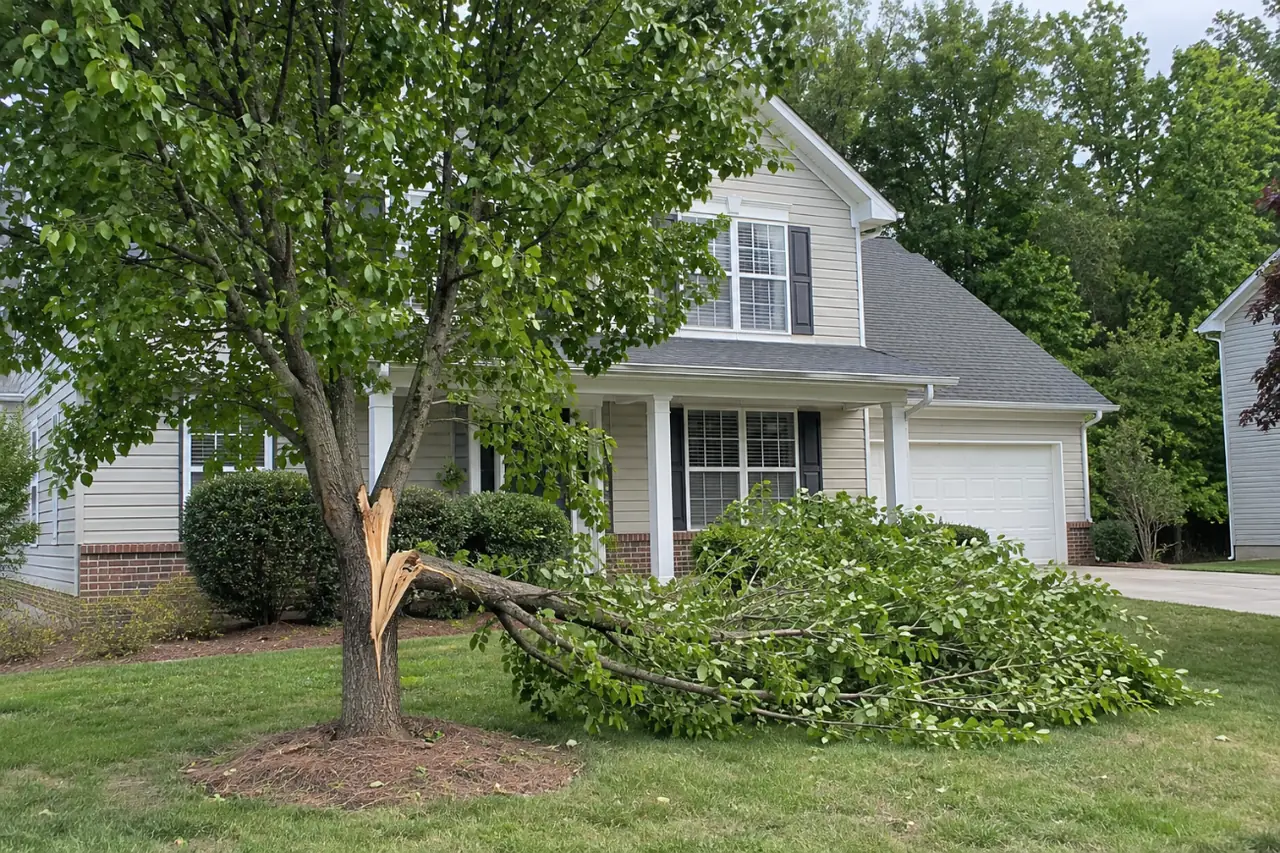
Bradford and other Callery pears in Wake Forest, NC split apart as they grow because their tight, upright branching and fast growth make weak branch unions; NC State Extension says that "eventually, the tree can break under its own weight" (AG-986, July 10, 2025, checked Nov 21, 2026). Taking one down is a modest job, but the stump resprouts unless it's treated within minutes of the cut.
To have a pear taken down and the stump dealt with, call (984) 324-0250. One independent local contractor will come out, look at it and price the job.
Why do Bradford pears split?
NC State Extension's publication on Callery pears puts it plainly: "the tree's acute branching structure and fast growth lead to weak branch unions" (AG-986, July 10, 2025, checked Nov 21, 2026). Several stems rise from close to the same point on the trunk at sharp angles. Wind, ice or the weight of a full crown of leaves can be enough to tear one of them away.
A split pear doesn't heal back together. Once a main stem has torn out, the rest of the tree is usually carrying the same weak unions.
Why does Extension want them gone?
The same publication says Bradford and other Callery pear varieties have "highly invasive traits," spreading along roadsides, fields, forest edges and wetlands and crowding out native plants. The wild offspring grow thorns that can reach 4 inches long, sharp enough to injure livestock and wildlife and puncture tractor tires. It notes that Ohio, South Carolina, Pennsylvania and Kansas enacted bans between 2021 and 2024, and that some localities restrict them.
They're common around town. The Town of Wake Forest's inventory of its own public trees counted 337 Callery pears, about 2 percent of the total (Wake Forest Urban Forest Management Plan, 2018, checked Nov 21, 2026), and that count doesn't include the ones in private front yards.
How is a Bradford pear removed so it stays gone?
- The tree comes down. It's taken down in sections, or dropped whole where there's room. One that has already split is cut carefully, since the torn stem may still be hanging on by bark and wood under tension.
- The stump gets treated right away. Extension says applying a targeted herbicide to the freshly cut stump is often necessary to get rid of a Callery pear for good, because it resprouts from the roots. It names glyphosate or triclopyr and says that if the herbicide isn't on within 5 to 10 minutes of the cut, the stump may need to be recut first.
- The stump is ground, if you want the spot back. Grinding can follow once the treatment has worked; see stump grinding.
- Sprouts get watched. Any shoots that come up from the roots afterward are easiest to deal with while they're small.
Ask whether the price includes the stump treatment, and who handles it. Herbicide labels are the law for how a product is used.
What is the NC Bradford Pear Bounty?
NC State Extension and its partners launched the NC Bradford Pear Bounty in 2022. Participants who remove Callery pears and show proof of removal can receive up to five native trees (AG-986, checked Nov 21, 2026). Check NC State Extension or the Wake County Extension office for upcoming bounty dates and pickup sites before the tree comes down, and take before-and-after photos either way.
What should I plant instead?
Extension suggests native trees with similar looks: flowering dogwood, eastern redbud, serviceberry, black cherry and Chickasaw plum. All of them flower in spring the way the pears do. The town's urban forest plan also pushes for a wider mix of species on its own streets, so a yard that mixes a few of these is in step with it. Keep anything planted under a power line short at full size; see trees and power lines.
What does it cost to remove a Bradford pear?
HomeGuide lists Bradford pear removal at $400 to $1,000, for a tree it puts at 30 to 50 feet tall when mature (HomeGuide, no date shown, checked Nov 21, 2026). For a smaller pear, the general ranges for any tree under 30 feet are $150 to $500 from HomeGuide, $285 to $435 from Lawn Love (updated Oct 5, 2026) and $150 to $450 from Angi (all checked Nov 21, 2026). Several pears in one visit, a split tree hanging over a car or roof, stump treatment and grinding all change the total. The cost page has the full tables.
Bradford pear questions
Can a split Bradford pear be saved?
Extension's publication describes the weak unions as built into the tree, so a pear that has torn once still carries the same structure. Removal and a native replacement is where Extension's publication points.
Does the town have to sign off before a Bradford pear comes down?
Not on a residential lot under 5 acres, unless it's a town street tree or part of a required buffer. Pears in the strip along the street may belong to the town; call Urban Forestry at 919-435-9565. See the town tree rules.
Is a Bradford pear the same as a Callery pear?
Bradford is one variety of Callery pear. Extension's publication covers Bradford and the other varieties together, along with their wild offspring.