
Wake Forest, NC Tree Rules: the Clearing Permit and Street Trees
Short version
Inside Wake Forest, NC, you can usually take a tree down on your own house lot without a town permit: the Tree Clearing Permit in Section 15.7.1 of the Unified Development Ordinance covers undeveloped land, and it exempts residential lots under 5 acres unless the trees belong to a required streetyard or buffer. Trees in the street right-of-way are a different matter, because the town's Urban Forestry program looks after them.
Below is what each rule says, with the section number and the date it was read. When a tree falls into one of the exceptions, call the town office listed before anyone cuts. For the tree work itself, call (984) 324-0250.
What does UDO Section 15.7.1 say?
The section opens by saying that, before any vegetation clearing or removal on undeveloped property, the owner or an authorized agent has to get a Tree Clearing Permit or show that an exemption applies. It defines undeveloped property as any property in the town's jurisdiction that isn't covered by an approved site plan or subdivision plan (UDO p. 15-14, checked Nov 21, 2026). The exemptions are:
- Normal forestry on land taxed under the present-use value standard, or done under a forestry management plan from a registered forester.
- Clearing done strictly according to a town-approved site or subdivision plan that hasn't expired.
- Vegetation removal by public or private agencies inside street rights-of-way, utility easements or other town property, as needed for public safety, clear visibility at driveways and intersections, survey work, or the upkeep of town property.
- Removal the town starts or approves of vegetation that is unsafe, a nuisance, a noxious weed, injurious to utilities or public improvements, or infected with a pest or fungus.
- "The removal of vegetation on a lot of record, less than 5 acres in size and zoned and/or used for residential purposes, provided such vegetation is not a portion of a required streetyard or other required riparian or landscaping buffer."
Exemptions 1 to 3: UDO p. 15-14. Exemptions 4 and 5, and the procedure below: UDO p. 15-15. July 19, 2022 edition of the ordinance, checked Nov 21, 2026.
When a permit is needed, it's handled by staff rather than a board. No land-disturbing activity can start until the clearing plans are reviewed and approved; staff act on a complete application within 30 days; an approved permit lasts no more than one year; and a denial can be appealed to the Board of Adjustment within 30 days of the written notice.
In plain terms: a homeowner taking down trees on a house lot under 5 acres doesn't need the Tree Clearing Permit. Someone clearing a wooded parcel that hasn't been through site or subdivision plan approval does, and so does anyone cutting trees that make up a streetyard, a riparian buffer or a landscaping buffer the town required.
How do I know if a tree is part of a required streetyard or buffer?
Those plantings are set when land is developed: the subdivision or site plan shows where a streetyard, a landscaping buffer between uses, or a stream buffer has to stay planted. They may sit in a common area or cross individual lots. Your recorded plat, the subdivision's approved plans and your HOA documents are where to look. If a strip of trees along a thoroughfare, at the back of your lot against a different kind of development, or beside a creek looks deliberately left, ask the town's planning staff before it's cut. Stream buffers have their own page: trees by creeks, ponds and Falls Lake.
What about tree save areas and specimen trees?
When a subdivision is designed, the UDO steers developers to keep trees in one contiguous tree save area, preferably in dedicated open space or a conservation easement. Once one is set, the ordinance says "All tree removal within TSA must have prior approval by the Administrator" (Sec. 8.4.2, p. 8-4, checked Nov 21, 2026). If your plat labels part of your lot TSA, removal there needs that approval, even for one tree. The same section names two exceptions: prior approval isn't required in an emergency caused by storm damage or to relieve an imminent hazard to public health, safety or welfare, and trees the Administrator finds to be in poor health, or invasive, exotic species, may be removed.
The same chapter defines specimen trees as trees in fair or better condition at least 20 inches across at breast height for canopy species, or 8 inches for understory species, and says every effort shall be made to preserve them (Sec. 8.4.3, p. 8-5, checked Nov 21, 2026). That standard works through development review. It is not a separate permit for an existing house lot, but it explains why big trees were saved where they stand in newer neighborhoods.
Who owns the trees along the street?
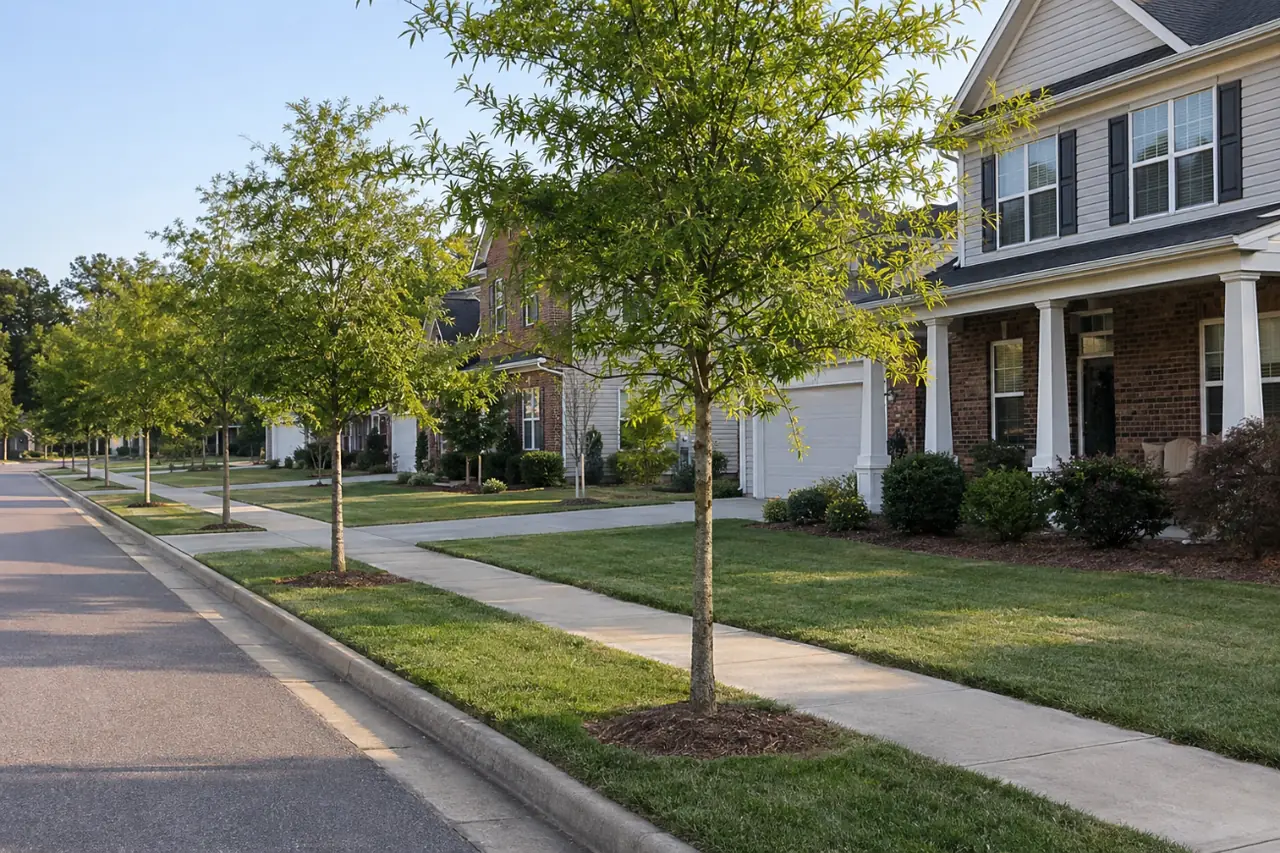
Often the town. Wake Forest's Urban Forestry program cares for trees and other vegetation on public property and rights-of-way, and administers the town's tree ordinance. It keeps an interactive map of street and park trees, stumps and forests that includes over 15,000 trees. The town says a tree growing across a property line is the shared responsibility of the town and the adjacent owner, that some ornamental trees on the map aren't actively maintained, that some newer developments haven't been inventoried yet, and that it aims to inspect each tree at least once every five years. Questions about whether the town maintains a tree go to Urban Forestry at 919-435-9565 (Town of Wake Forest Urban Forestry, checked Nov 21, 2026).
The town's Urban Forestry FAQ draws the lines more closely. Trees planted between the curb and the sidewalk, or between the curb and the property line, are considered within the public right-of-way. Trees in a street tree easement are often planted in an 8-foot zone outside the right-of-way, which the FAQ puts as 8 feet inside the homeowner's property line. Trees along streets that NCDOT maintains are NCDOT's to maintain, not the town's (Urban Forestry FAQs, checked Nov 21, 2026).
The town code backs this up. Section 34-37 gives the town the right to plant, prune, maintain and remove trees, plants and shrubs within the lines of public streets and grounds, and Section 34-38 makes topping street, park and other public trees unlawful as a normal practice (Code of Ordinances Chapter 34, checked Nov 21, 2026). The town's Urban Forestry Board was set up in 1978 as an advisory board to the Board of Commissioners (Town of Wake Forest, checked Nov 21, 2026).
How does a dead street tree get replaced?
In new subdivisions the developer plants the street trees in the right-of-way or a street tree easement granted to the town. Urban Forestry inspects them, the developer carries a one-year warranty, and after a second inspection the town takes over. When a town-maintained street tree dies, a resident usually reports it. Once the dead tree is removed and the stump ground, the address goes on the planting list, which is worked first come, first served. The stump may instead be left as a marker for the landscape contractor, because having the landscaper pull a small stump costs less than having the tree maintenance contractor grind it. Planting runs October 1 through March 31 (Street Tree Replacement, checked Nov 21, 2026). Public Works is at 919-435-9570.
What can the town require of me as an owner?
Chapter 34 puts these duties on private owners (Sections 34-39 and 34-40, checked Nov 21, 2026):
- Keep a clear space of 8 feet above any street or sidewalk your trees hang over.
- Keep branches from blocking streetlights or the view of an intersection. The town may prune private trees and shrubs that block streetlights or traffic signs.
- Take down trees that are dead, diseased or dangerous, and cut out broken or decayed limbs, where they menace public safety.
- If the town serves notice to remove a dead or diseased tree that's a hazard or threatens other trees, you have 60 days to do it at your own expense. After that the town may remove it and add the cost to your property tax notice.
Are there tree rules in the historic district?
The town has one locally designated district, the Local Wake Forest Historic District, where any exterior work needs a Certificate of Appropriateness; minor-work certificates are reviewed by staff for a $25 fee (Historic Preservation FAQs, checked Nov 21, 2026). The same FAQ lists Glen Royall Mill Village, Wake Forest and Downtown Wake Forest as National Register districts; the certificate requirement it describes is for the local district.
The town's 2021 handbook and design guidelines say mature trees should only be removed for disease, storm damage, structural damage to a historic building, or damage to utility lines; that a tree lost to disease or storm should be replaced with the same species or one that will reach a similar canopy; and that owners should consult an arborist or the town's urban forestry coordinator before taking down any tree 8 inches or more in diameter at chest height, or cutting any limb 4 inches or thicker (Historic Property Handbook & Design Guidelines, p. 42, checked Nov 21, 2026). The historic preservation planner is at 919-435-9516.
Does my HOA have its own say?
It can. HOA covenants are a private agreement among owners, separate from town law, and some include an architectural review section that covers trees. A tree in a common area belongs to the association. Read the covenants, or ask the management company, before scheduling work.
Is the ordinance about to change?
The town is rewriting its UDO, which was first adopted in 2013. Its UDO page says the 2026 draft was set for public comment and a Planning Board recommendation at the November 10, 2026 meeting, with a public hearing and adoption by the Board of Commissioners anticipated in January 2027, and that the current UDO remains in use until the rewrite is adopted (Town of Wake Forest UDO page, checked Nov 21, 2026). This page reads the ordinance in force now; the town's UDO page will carry the adopted text once the rewrite passes.
Who do I call at the town?
| Question | Office | Phone |
|---|---|---|
| Is this a town street tree? Who maintains it? | Urban Forestry | 919-435-9565 |
| Street tree replacement, Public Works operations | Public Works | 919-435-9570 |
| Trees in the local historic district | Historic preservation planner | 919-435-9516 |
| Everything else | Town Hall main line | 919-435-9400 |
| Limb on a Wake Forest Power line | Wake Forest Power outages | 919-435-9478 |
| Tree that may be threatening a Wake Forest Power line or your service | Wake Forest Power | 919-435-9573 |
Numbers from the Town of Wake Forest's Urban Forestry, Street Tree Replacement, Historic Preservation and Wake Forest Power pages (the last also lists the Town Hall line), checked Nov 21, 2026.
Tree rule questions
Can I take down every tree on my half-acre lot?
Under the town's Tree Clearing Permit, generally yes, as long as none of them sits in a required streetyard, buffer or tree save area. Your HOA may still have rules, and the creek buffer rules apply near water.
My lot is 6 acres. Do I need the permit?
The house-lot exemption stops at 5 acres. If the land is already covered by an approved site or subdivision plan, the clearing has to follow that plan; if it isn't, a permit or another exemption, such as forestry on present-use value land, applies. Ask town planning staff before cutting.
Does any of this apply in Rolesville or north Raleigh?
No. These are Town of Wake Forest rules. Rolesville has its own tree removal permit, and the City of Raleigh and Wake County have their own codes.