
Trees by Creeks, Ponds and Falls Lake in Wake Forest, NC
Short version
In Wake Forest, NC, trees growing in the first 50 feet back from a creek, pond or lake usually stand in a riparian buffer that state and town rules keep natural: the first 30 feet from the bank is left undisturbed, and the next 20 feet stays vegetated. Taking out an individual tree that is dead, diseased or damaged, or one that threatens a house or a utility line, is among the uses the state rule lists; clearing healthy trees to open a view is not something to do without checking first.
Lots that back up to Smith Creek, Richland Creek, a neighborhood pond or the Falls Lake shoreline are where this comes up most. For the tree work, call (984) 324-0250; for the buffer question, the town office is listed below.
Which creeks and ponds have a buffer?
Chapter 12 of the Wake Forest UDO says riparian buffers shall be maintained for all perennial and intermittent streams, lakes and ponds. A stream or pond counts if it shows on a USGS topographic map or an NRCS soil survey map, if the state's stream identification method finds it, or if other site-specific evidence does (UDO Sec. 12.7.1, p. 12-35, checked Nov 21, 2026). The buffer is measured landward from the top of the bank, or from the edge of the rooted plants along it.
Man-made or isolated ponds that aren't part of a natural drainage way and aren't hydraulically connected to other waters are exempt. A pond fed by an intermittent or perennial stream, or draining straight into one, counts as part of the drainage way, so most neighborhood ponds on a creek carry a buffer.
How wide is the buffer?
Wake Forest is among the local governments carrying out the state's Neuse River stormwater rule (Town of Wake Forest, checked Nov 21, 2026). The state's Neuse buffer rule sets Zone 1 at 30 feet from the bank and Zone 2 at a further 20 feet, for a combined 50 feet on every side of the water. Zone 1 is to stay a vegetated area that is undisturbed except for the uses the rule lists; Zone 2 can be graded and replanted as long as Zone 1 isn't harmed (15A NCAC 02B .0714, readopted effective June 15, 2020, checked Nov 21, 2026). The town's Chapter 12 update also cites the state's model stormwater ordinance for the Tar-Pamlico basin next door.
The town's own table uses the same 30- and 20-foot zones. For the Falls Lake, Richland Creek and Smith Creek water supply watersheds it adds a third zone of 50 feet in some cases, such as perennial streams under the high-density option, and not along intermittent streams. All buildings and structures have to stay at least 10 feet back from the edge of any required buffer (UDO Sec. 12.7.2, p. 12-36, checked Nov 21, 2026). The approved subdivision or site plan is the place to look for the buffer lines on a given lot.
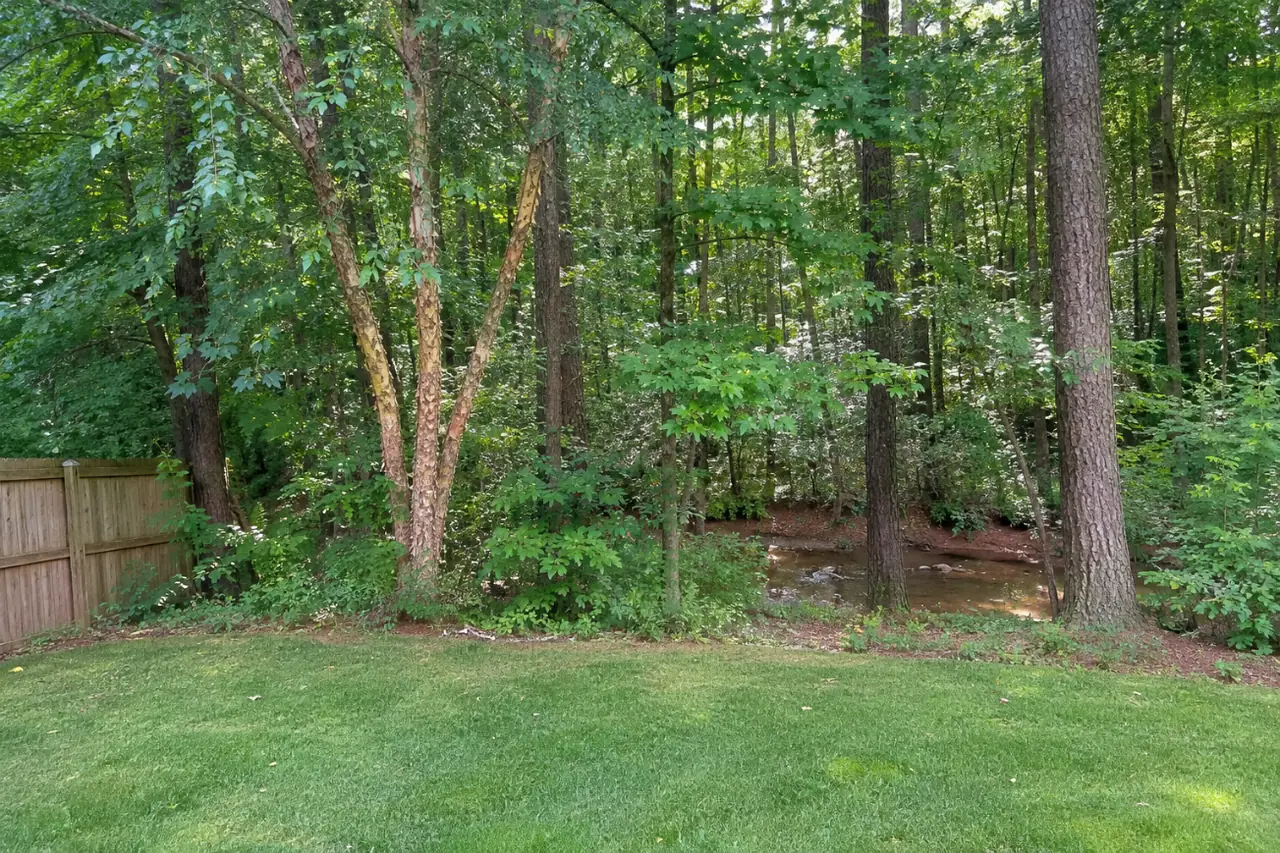
What can be done to trees inside the buffer?
The town's rule is short: all required buffers "shall remain natural and undisturbed" except as the state rules allow (UDO Sec. 12.7.3.A, p. 12-37, checked Nov 21, 2026). The state rule's table of uses includes, among others:
- removal of individual trees that are dead, diseased or damaged;
- removal of individual trees, branches or limbs in danger of damaging a house, an existing utility line, another structure or human life, or imminently endangering the stream bank, provided the stumps are left or ground in place without causing more land disturbance;
- pruning forest vegetation, as long as its health and function aren't compromised;
- periodic mowing and harvesting of plant products, in Zone 2 only.
The state rule sorts uses into five designations: deemed allowable, allowable upon authorization (which means a written Authorization Certificate before the work), allowable with mitigation upon authorization, allowable with exception, or prohibited. Because some uses need that written approval first, treat anything beyond taking out an obviously dead, storm-broken or threatening tree as a question for the town before work starts.
What about the lawn that already runs to the creek?
The state rule exempts the part of a buffer that holds an existing, ongoing use, with maintained lawns named as the example: grass kept down with a mower alone, no chainsaw or bush-hog needed. To count as existing, the use has to have been there as of July 22, 1997 and continued since, or have been allowed under an authorization certificate or variance (15A NCAC 02B .0714, checked Nov 21, 2026). Only the footprint of that lawn is exempt. A lawn kept up since before then can keep being mowed; letting it grow into woods and clearing it later is a different matter.
What about lots near Falls Lake?
Falls Lake is a federal reservoir. The U.S. Army Corps of Engineers created it by finishing a dam on the Neuse River in 1981 and designed it for regional water supply and flood prevention, and it supplies drinking water to Raleigh and surrounding areas (City of Durham, checked Nov 21, 2026).
Where a house lot backs toward the lake, the wooded strip beyond the yard may be government project land rather than part of the lot; the recorded survey or plat shows where your line is. Federal rules for Corps lake shorelines say vegetation modification by private individuals, including cutting, pruning and removal, is allowed only in certain designated areas and only under a permit, and not at all in public recreation areas (36 CFR 327.30, checked Nov 21, 2026). Don't cut, top or limb trees past your property line toward the lake; ask the Corps first.
Who answers buffer questions?
For lots inside Wake Forest, Chapter 12 of the UDO is handled by the town's Engineering Department, which lists its director at 919-435-9438 on its Chapter 12 update page (Town of Wake Forest, checked Nov 21, 2026). Have your address and, if you can, a photo of the tree and the creek bank when you call.
How should tree work near a creek be done?
- Cut a dead or storm-broken tree and move the wood out of Zone 1 by hand or with a winch, rather than driving equipment down the bank.
- Leave the stump and roots in the ground. The state rule's line for hazard trees asks for stumps left or ground in place without more land disturbance, and a stump left alone keeps the bank soil where it is.
- Keep brush and logs out of the creek and off the bank, where high water can carry them downstream.
- Healthy trees leaning over the house but rooted in the buffer are the hard case; get the town's answer in writing before anything is cut.
Creek and lake questions
A dead pine in the buffer is leaning toward my deck. Can it come out?
Removal of an individual dead, diseased or damaged tree is on the state rule's list of uses, and so is a tree in danger of damaging a house, which makes this the most straightforward case. Call the town to confirm, keep the stump in the ground, and keep machines out of Zone 1.
Can I clear the brush to see the creek?
Not by clearing Zone 1. The rule keeps that zone undisturbed. Pruning that doesn't hurt the health of the trees is on the list; opening a view by cutting healthy trees and undergrowth isn't.
Does this apply in Rolesville or Raleigh too?
The state buffer rules apply by river basin, not by town, and each town has its own ordinance on top of them. See the Rolesville page for that town's tree rules.