
Tree Trimming and Pruning in Wake Forest, NC
Short version
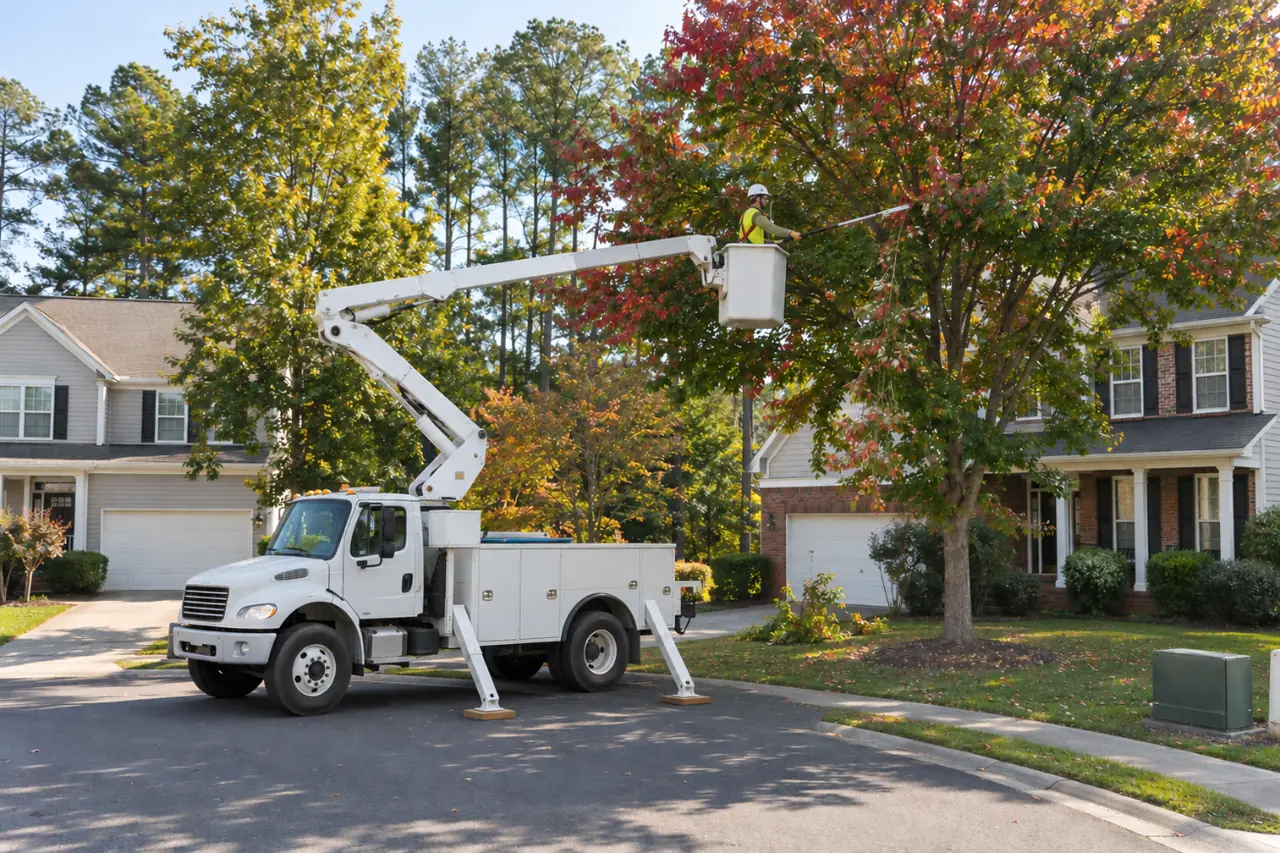
Tree trimming in Wake Forest, NC usually means taking dead limbs off over the roof, raising branches that hang low over the driveway or sidewalk, and thinning weight from long oak and maple limbs before storm season. LawnStarter's trimming guide (updated Sept 24, 2026) puts a typical tree at $430 to $640, with tall trees costing more (checked Nov 21, 2026).
The town's code also asks owners to keep 8 feet of clear space over streets and sidewalks. One independent local contractor can look at the tree and tell you what it needs; call (984) 324-0250 or send the form.
What does a pruning visit cover?
A pruning job is priced by the tree and by what comes off it. Around Wake Forest the common requests are:
- Deadwood removal. Dead limbs in an oak or maple crown fall first in wind and ice, and the ones over a roof, deck or driveway are the priority.
- Roof and gutter clearance. Limbs resting on shingles or brushing siding get cut back to a side branch or the trunk.
- Raising the crown. Low branches come off so people can walk the sidewalk and cars can use the driveway, which is also what the town's clearance rule asks for.
- Thinning and weight reduction. A long limb reaching out over the house can be shortened to a side branch to take load off its base.
- Clearance from the line to your house. Utilities clear their own distribution lines. For Duke Energy customers, the drop from the pole to the meter is largely the owner's to keep clear (Duke Energy, checked Nov 21, 2026); Wake Forest Power customers can call 919-435-9573 to have a tree inspected that may be threatening their service (Wake Forest Power, checked Nov 21, 2026). See trees and power lines.
What is the town's 8-foot clearance rule?
Chapter 34 of the Town of Wake Forest Code of Ordinances, which covers trees, puts several duties on owners whose trees overhang public space (Chapter 34, Vegetation, checked Nov 21, 2026):
- Section 34-39 says owners of trees overhanging a street or sidewalk keep "a clear space of eight feet above the surface of the street or sidewalk."
- The same section says branches must not block the light from a streetlight or the view of an intersection, and lets the town prune trees on private property that block streetlights, traffic signs or signals.
- Owners also have to take down trees that are dead, diseased or dangerous, and cut out broken or decayed limbs, where they menace public safety.
- Under Section 34-40, the town can order a dead or diseased tree that is a hazard removed. The owner has 60 days from the notice; after that the town can remove it and put the cost on the owner's property tax notice.
A crown raise that clears the sidewalk by 8 feet and the street enough for a garbage truck takes care of most of this in one visit.
Why is topping the wrong cut?
Topping is the practice of sawing a tree's top, or its main limbs, back to stubs to shrink it. Wake Forest's code makes topping street, park and other public trees unlawful as a normal practice (Sec. 34-38), and Rolesville's ordinance says much the same about its street and park trees (Rolesville LDO Sec. 6.2.5.10, checked Nov 21, 2026). On a private tree it's legal but works against you: the shoots that sprout from a stub are thin and loosely attached, and the stub itself tends to rot back into the limb. If a tree is simply too big for where it stands, removal and a better-sized replacement usually make more sense than repeated topping.
Crape myrtles are often cut this way. They make up 12 percent of the trees in the town's public inventory, the same share as red and Freeman maples (Wake Forest Urban Forest Management Plan, 2018, checked Nov 21, 2026). Thinning crossing stems at the base keeps them in bounds without the knuckled stubs.
What do Wake Forest's common trees need?
The town's 2018 urban forest plan lists the pests it watches on the species that line Wake Forest streets, and the same trees fill most yards:
| Tree | Share of town inventory | Problem the plan notes |
|---|---|---|
| Red oak group (including willow oak) | 20% | Orange-striped oakworm on red oaks; lecanium scale on willow oaks |
| Red and Freeman maple | 12% | Gloomy scale |
| Crape myrtle | 12% | Crapemyrtle bark scale, first detected in North Carolina in 2016 |
| Loblolly pine | 2% | Breakage and bark beetles (see the pine page) |
| Callery pear | 2% | Weak branch unions (see the Bradford pear page) |
Source: Wake Forest Urban Forest Management Plan, accepted 2018, Table 1 and pest notes, checked Nov 21, 2026.
In the plan's 2017 sample of 286 willow oaks, 41 percent were in good condition, 53 percent fair and 6 percent poor. Older willow oaks with thinning crowns are where pruning out deadwood buys time, and where a hard look tells you whether the tree is still worth pruning. The dying oaks page covers the signs.
Are there extra steps in the historic district?
Yes, for the local Wake Forest Historic District. The town's 2021 historic property handbook asks owners to consult an arborist or the town's urban forestry coordinator before cutting any limb 4 inches or thicker, and before taking down any tree 8 inches or more in diameter at chest height (Historic Property Handbook & Design Guidelines, p. 42, checked Nov 21, 2026). The town says any exterior work in the local district needs a Certificate of Appropriateness, and its historic preservation planner answers questions at 919-435-9516 (Historic Preservation FAQs, checked Nov 21, 2026).
What does pruning cost?
| Tree height | Pruning, per tree (national) |
|---|---|
| Small tree, up to 30 ft | $85 to $415 |
| Medium tree, 30 to 60 ft | $215 to $790 |
| Tall tree, above 60 ft | $475 to $1,835 |
| Typical tree, any height | $430 to $640 |
Source: LawnStarter's tree trimming cost guide (page dated Sept 24, 2026), checked Nov 21, 2026.
A tall pine or oak over a house, a backyard with no truck access, and limbs near the service line push a job toward the top of these ranges. The cost page has more.
Pruning questions
When is the best time to prune?
Dead and broken limbs can come off any time of year. Shaping cuts on live wood are often done in the dormant months, when the leaves are down and the branch structure is easy to see. Clearing the deadwood out of a big oak over the house in spring takes away the limbs most likely to land on the roof before summer thunderstorms arrive.
How often should a big yard tree be pruned?
It depends on the tree and what's under it. For its own trees, the town aims to inspect each one at least once every five years (Urban Forestry, checked Nov 21, 2026), which is a sensible rhythm for a large oak over a house too.
Who prunes the street tree in front of my house?
If it's a town-maintained tree, Urban Forestry does. Call 919-435-9565 before anyone cuts it; trees that straddle the property line are a shared responsibility between the town and the owner.