
Dying Oak and Ash Trees in Wake Forest, NC
Short version
An oak in Wake Forest, NC that browns early every summer, thins out year after year, or keeps dropping dead limbs may have bacterial leaf scorch, scale, Hypoxylon canker or the slow, many-cause problem called oak decline; an ash with a thinning crown and D-shaped holes in the bark most likely has emerald ash borer, which was confirmed in both Wake and Franklin counties in 2015. NC State Extension says leaf scorch on oaks progresses every year (checked Nov 21, 2026).
Whether a sick tree needs pruning or removal is a call to make on site. Call (984) 324-0250 to have one independent local contractor inspect the tree and price whatever it needs.
Which trees does this cover?
Oaks shape Wake Forest's streets. In the town's own inventory of public trees, the red oak group, which includes willow oaks, makes up 20 percent of all trees, more than any other group. When the town sampled 286 willow oaks in 2017, 41 percent were in good condition, 53 percent fair and 6 percent poor, and the plan recommends planting fewer willow oaks, red oaks, maples and crape myrtles to spread the risk (Wake Forest Urban Forest Management Plan, 2018, checked Nov 21, 2026). The same species fill many yards around town.
What is bacterial leaf scorch?
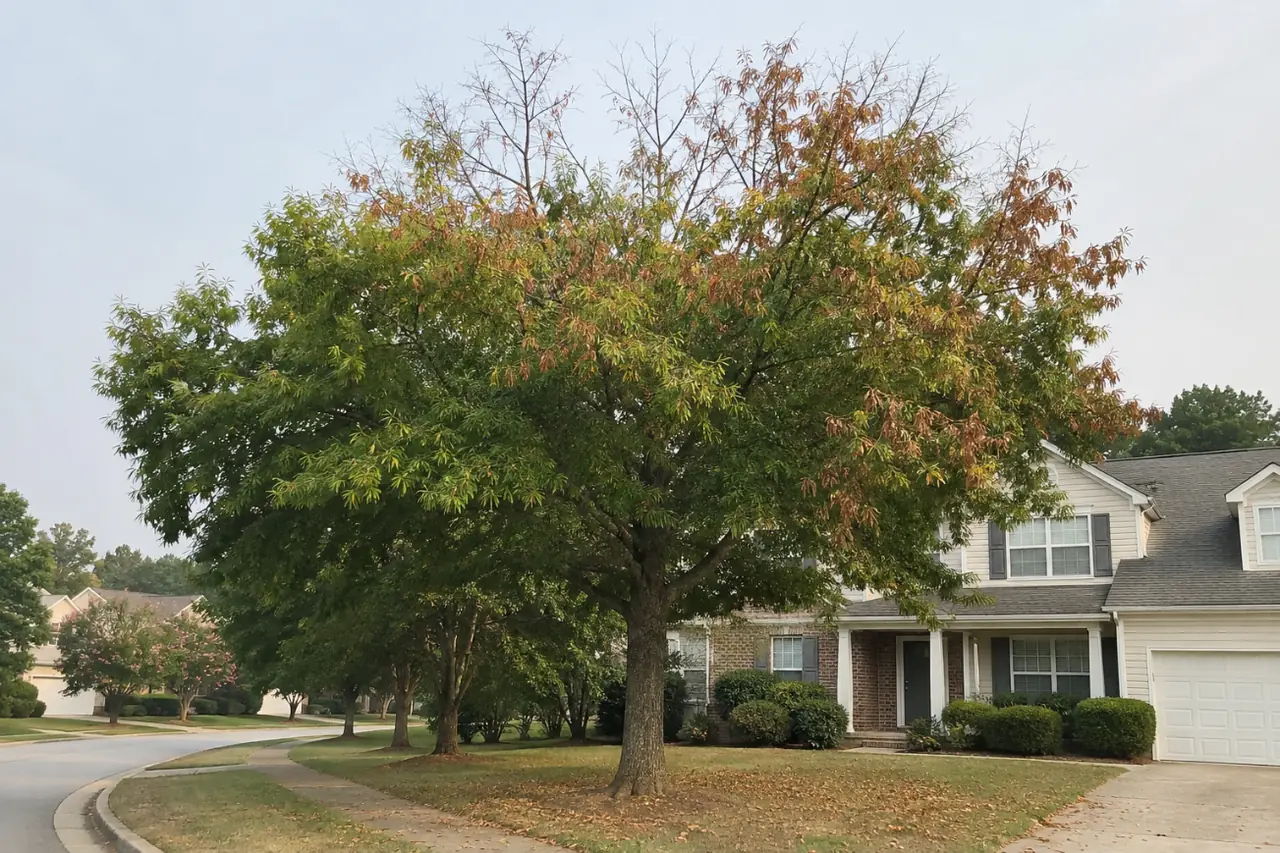
NC State Extension's guide to oak diseases in North Carolina says bacterial leaf scorch most often affects red oak, white oak, pin oak and shingle oak. It looks like drought stress: leaf tips and edges brown, often with a yellow band between the brown and the green, and leaves drop early, usually in mid to late summer. The guide says the disease progresses every year, causing more symptoms over time (NC State Extension, April 5, 2022, checked Nov 21, 2026).
Because it looks so much like drought, the clue is repetition: scorch comes back on the same tree summer after summer and spreads further each time.
What are Hypoxylon canker and oak decline?
The same Extension guide describes two problems that often travel together on older oaks:
- Hypoxylon canker (also called Biscogniauxia canker) is opportunistic. The guide says it attacks trees already weakened or stressed by other factors or pests.
- Oak decline isn't one pest or disease. The guide says it comes from pests, diseases and the environment acting together, often starting with poor growing conditions.
- Armillaria root rot becomes a problem in older or stressed trees, and the guide notes that the fungus can live on in old wood and soil after the tree is gone.
Fungus growing at the base of the trunk, bark falling away in sheets, and big dead limbs high in the crown are the signs that a tree's structure, not just its leaves, is involved. That's when removal comes into the conversation.
Are insects part of it?
The town's urban forest plan names the insects it watches on its own trees: lecanium scale on willow oaks, gloomy scale on red and Freeman maples, orange-striped oakworm on red oaks, and crapemyrtle bark scale, first detected in North Carolina in 2016. Each one is another stress on a tree, and stress is where canker and decline get their start.
How do I know if emerald ash borer has hit my ash?
Emerald ash borer was first detected in Wake County on June 19, 2015 and in Franklin County on July 15, 2015 (NC Forest Service, September 2015, checked Nov 21, 2026). The Town of Wake Forest's emerald ash borer page, which carries no date, says the two counties were added to the emerald ash borer quarantine. That quarantine is over: the state now considers all of North Carolina infested and lifted its statewide quarantine in 2026 (NCDA&CS, checked Nov 21, 2026).
The town's page counts 87 ash trees along public rights-of-way, and it says the bigger concern is the many ash trees on private property, in neighborhood open spaces and in forested areas (Town of Wake Forest, Emerald Ash Borer, checked Nov 21, 2026). The signs the town lists:
- D-shaped exit holes in the bark
- Winding tunnels under the bark
- Dieback and a thinning crown
- New shoots sprouting along the trunk and branches
- Bark splitting vertically
- More woodpecker activity than usual
The plan that page describes for the town's own ash trees covers monitoring, treatment, removal and replacement, which are also the choices a homeowner has. Which one fits depends on how far the borer has gone, and that's a call to make on site. If removal is the answer, HomeGuide lists ash tree removal at $800 to $1,900 and Angi at $250 to $1,800 (HomeGuide and Angi, no date shown on either, checked Nov 21, 2026). The town's page also points people to the "Don't Move Firewood" advice: buy firewood locally and burn it within 10 miles of where it was bought.
Prune, treat or take it down?
| What you see | Usually points to |
|---|---|
| A few dead limbs, the rest of the crown full | Pruning out deadwood and keeping an eye on it |
| Browned leaf edges every late summer on the same tree | Leaf scorch, which gets worse each year; plan ahead |
| Crown thinning from the top over several years | Decline; get it looked at before big limbs start falling |
| Fungus at the base, bark sloughing off in sheets | Root or trunk decay; removal is usually discussed |
| Ash with D-shaped holes and dieback | Emerald ash borer; treat early or remove |
Near the street, the town code also requires owners to remove dead, diseased or dangerous trees and broken limbs that threaten public safety, and lets the town order a hazardous dead or diseased tree removed within 60 days (Chapter 34, Secs. 34-39 and 34-40, checked Nov 21, 2026).
Questions about sick oaks and ash
Is a dying oak a liability if it falls on the neighbor's house?
It can be. NC State Extension's farm law team says owners have a duty to deal with reasonably foreseeable dangers, and names a dead or visibly dying tree among the warning signs a court may weigh (NC State Extension, July 25, 2021, checked Nov 21, 2026).
What should I plant where the old oak was?
The town's plan pushes for more variety in what gets planted. A different species from the one you lost, set a few feet from the old root zone, is a reasonable start; the Bradford pear page lists the native flowering trees NC State Extension suggests in place of Callery pears. Check how big each one grows before choosing a spot.
Does the town remove sick trees on private property?
No, but it can order one removed if it's a dead or diseased hazard or threatens other trees. Trees in the public right-of-way are Urban Forestry's (919-435-9565).