
Tree Removal in Wake Forest, NC
Short version
Most tree removal on a Wake Forest, NC house lot needs no permit from the town, because residential lots under 5 acres are exempt from its Tree Clearing Permit unless the trees sit in a required streetyard or buffer. What does need sorting out first is whose tree it is, how it can come down without hitting the house, and where the wood goes afterward.
Call (984) 324-0250 or send the form; the independent contractor who takes Wake Forest requests visits, works out how the tree can safely come down, and gives you a price.
Does the Town of Wake Forest need to sign off first?
Section 15.7.1 of the town's Unified Development Ordinance says that before vegetation is cleared or removed on undeveloped property, the owner gets a Tree Clearing Permit or shows that an exemption applies. "Undeveloped" there means land not covered by an approved site or subdivision plan. One of the listed exemptions is the removal of vegetation on a lot of record under 5 acres that is zoned or used for residential purposes, as long as the vegetation isn't part of a required streetyard or a required riparian or landscaping buffer (UDO p. 15-14 and p. 15-15, July 19, 2022 edition, checked Nov 21, 2026).
So for a typical house in Heritage, removing a backyard pine is your call. Four situations change that:
- The tree grows in the grass strip along the curb, or in a street tree easement. Wake Forest's Urban Forestry program looks after trees on public property and in rights-of-way, so call 919-435-9565 first (Urban Forestry, checked Nov 21, 2026).
- Your plat shows a tree save area. The UDO says all tree removal within a tree save area must have the Administrator's approval beforehand, except in a storm-damage emergency or to relieve an imminent hazard (Sec. 8.4.2, p. 8-4, checked Nov 21, 2026).
- The tree is within 50 feet of a creek, pond or lake. State and town buffer rules keep that strip natural. See trees by creeks.
- The house is in the local historic district, where exterior work needs a Certificate of Appropriateness (Historic Preservation FAQs, checked Nov 21, 2026) and the design guidelines ask owners to get advice before any tree 8 inches or wider at chest height comes out (Historic Property Handbook & Design Guidelines, 2021, p. 42, checked Nov 21, 2026).
The Wake Forest tree rules page quotes each of these. The town is also rewriting its development ordinance: a 2026 draft was set to go before the Planning Board on Nov 10, 2026, with adoption by the Board of Commissioners expected in January 2027, and the current UDO stays in use until then (Town of Wake Forest, checked Nov 21, 2026).
How does a tall tree come down next to a house?
The method is set by how much open ground lies around the tree, which way it leans, and what's underneath. In many Wake Forest subdivisions, two-story houses sit close together under loblolly pines taller than the roof, which leaves little open ground to drop a whole tree.
Felling in one piece
Where there's open lawn in the direction of the lean, a climber or ground crew can notch the trunk and drop the whole tree. It's the quickest way, but it needs a clear landing zone longer than the tree is tall.
Taking it apart from the top
When the tree stands between a house, a fence and a neighbor's shed, a climber goes up on ropes and spikes, cuts the limbs, and lowers each piece on a rope run through a pulley tied higher in the tree. The trunk comes down last in short sections. It takes longer and costs more, but no piece drops uncontrolled onto the roof.
Crane removals
A truck crane is the answer when a big pine or oak hangs over the house and has nowhere to drop. The crane sets its outriggers on wooden cribbing pads on the driveway or street, a climber rigs each section, and the operator lifts it over the roof to the ground crew. HomeGuide prices a crane at $500 to $2,500 per day, billed in addition to the removal (HomeGuide, checked Nov 21, 2026).
Bucket trucks
Where the tree stands near the curb or a driveway the truck can reach, a bucket truck puts the cutter in the canopy without climbing. Backyards behind fences and on slopes down to a creek are usually out of a bucket truck's reach.
Which Wake Forest trees come down most?
Loblolly pines. They grow tall and straight with the crown bunched at the top, which is why ice and wind snap them at the trunk. A pine that has started to lean after a storm, or whose needles have turned from green to yellow to rust, is a common removal; the pine page covers both.
Oaks. The red oak group alone makes up 20 percent of the trees in the town's public inventory, and willow oaks line many older streets (Wake Forest Urban Forest Management Plan, 2018, checked Nov 21, 2026). An old oak with a hollow trunk, dead scaffold limbs or fungus at the base gets a hard look; see dying oaks and ash.
Bradford pears, sweetgums and tulip poplars. Callery pears split as they age, sweetgums shed spiky seed balls over patios and gutters, and tulip poplars grow tall beside houses. The Bradford pear page explains why a pear stump keeps sprouting.
Where do the wood and brush go?
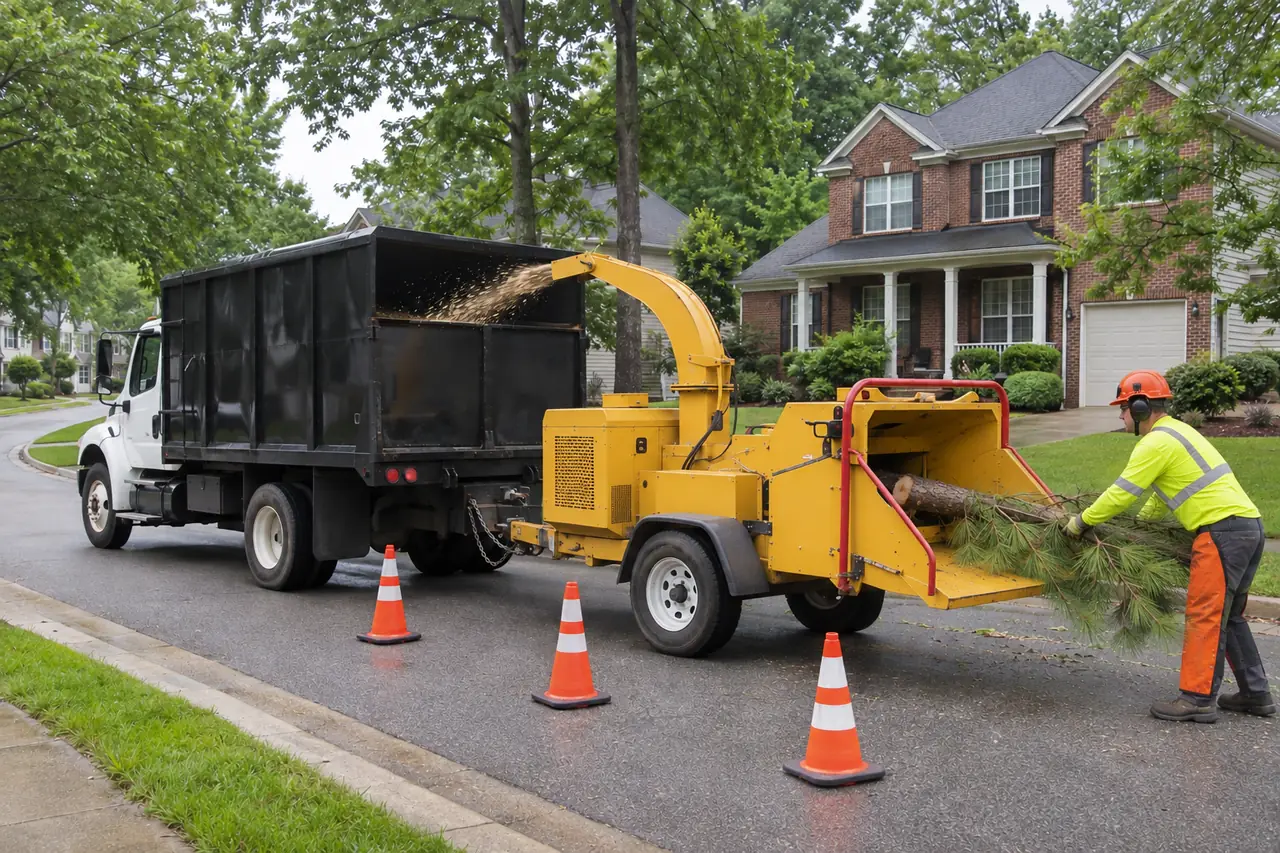
Ask before the job starts whether the price includes hauling everything away, chipping the brush only, or leaving the logs. Here is what the town will and won't pick up, from the Town of Wake Forest yard waste rules (checked Nov 21, 2026):
- Yard waste is collected weekly, one business day before trash day, and brush needs no appointment.
- Brush goes to the curb loose and unbundled, under 10 inches across and no longer than 6 feet. Logs over 6 inches across must be cut to 2 feet or shorter.
- The limit is 8 cubic yards of brush per household per week. Large amounts from removing more than one tree, or from land clearing, are not collected.
- Material a contractor prunes or cuts can be collected if it meets the town's guidelines, sits in front of the individual home rather than a common area, and goes out no earlier than 5 p.m. the day before collection.
- Stumps, roots and logs too big for the regular truck go in a separate pile for the knuckleboom truck.
Burning isn't the fallback: North Carolina's air quality rules don't allow yard waste to be burned where public pickup is provided (NC DEQ, checked Nov 21, 2026). If the tree was an ash and you keep the wood for the fireplace, burn it at home. Emerald ash borer was found in Wake and Franklin counties in 2015 (NC Forest Service, September 2015, checked Nov 21, 2026), and North Carolina now treats the whole state as infested; the state lifted its quarantine in 2026 (NCDA&CS, checked Nov 21, 2026). The town's emerald ash borer page points people to the "Don't Move Firewood" advice: buy firewood locally and burn it within 10 miles of where it was bought (Town of Wake Forest, checked Nov 21, 2026).
How should I get the yard ready?
- Move cars out of the driveway and off the street in front of the house; the chipper and truck need the curb.
- Unlock gates and mention how wide the narrowest one is. It decides whether a tracked lift or grinder can reach the backyard, or whether the wood comes out by hand.
- Point out irrigation heads, invisible dog fence wire, lighting cable and anything buried near the tree.
- Let the neighbors know if limbs hang over their side or the crew needs to set up along the shared fence line.
- Keep children and pets inside while cutting and chipping are going on.
When is removal the wrong answer?
A healthy oak with one dead limb over the roof usually needs pruning, not removal. A street tree the town maintains is the town's job. And a tree inside a creek buffer may be one only the state rules allow you to touch if it's dead, diseased or damaged. The contractor can tell you on site which of these you're looking at.
Tree removal questions
How much does it cost to remove a tree in Wake Forest, NC?
National guides put one removal at about $385 to $1,070, averaging $630 (LawnStarter, updated Oct 5, 2026, checked Nov 21, 2026). Height, the crane, the brush and the stump move it from there; the cost page breaks it down.
Does the stump come out too?
Not unless you ask. A removal ends with the trunk sawn off low, and grinding the stump below the grass is its own item on the written price. See stump grinding.
My neighbor's tree is leaning toward my house. Can I make them remove it?
North Carolina has no statute on it. Courts use a negligence standard, so an owner can be held responsible when a tree falls and the danger was reasonably foreseeable: a dead tree, one leaning hard toward the neighbor, or one with a big anchoring root cut (NC State Extension, July 25, 2021, checked Nov 21, 2026). Talking with the neighbor, in writing, is the usual first step.