
Emergency Tree Service in Wake Forest, NC
Short version
When a storm puts a tree on your house, car or driveway in Wake Forest, NC, get everyone away from the damaged part of the house, treat any wire as live and call the electric company, then call for tree help. A North Carolina homeowners policy generally pays toward removing a tree that landed on a structure or blocked the driveway, capped at $500 for one loss, according to the NC Department of Insurance (checked Nov 21, 2026).
For the tree itself, call (984) 324-0250. The call reaches one independent contractor serving Wake Forest and the towns around it, who comes out to see the damage and prices getting the tree off and the roof clear.
What should I do in the first hour?
- Move everyone out of the rooms beneath the trunk. A tree lying across a roof can settle or slide as limbs give way or the wind rises again.
- Treat every downed or sagging wire as energized. Duke Energy's advice is to always assume a downed line is live and stay away, and never touch it or drive over it (Duke Energy, checked Nov 21, 2026). Keep children and pets inside.
- Call 911 if anyone is hurt, if you smell gas, or if a line is down across a road.
- Call your electric company. The Town of Wake Forest's outage page lists Wake Forest Power at 919-435-9478, Duke Energy Progress at 800-419-6356 and Wake Electric at 855-280-1147 (Town of Wake Forest, checked Nov 21, 2026). The number on your own bill works too.
- Take photos of the tree, the roof, the inside ceilings and any car before anything is moved. Your adjuster will want them.
- Leave the chainsaw in the shed. Storm-broken trunks and limbs are often bent under tension and can whip when cut. That's the part to leave to a crew.
What if the tree is tangled in power lines?
Then nobody but the utility touches it first. North Carolina's Overhead High-Voltage Line Safety Act keeps equipment at least 10 feet from a high-voltage line until the danger of contact is guarded against, and the line's owner has to be told first: 48 hours ahead in normal work, not counting Saturdays, Sundays or legal holidays, and as soon as possible in an emergency (G.S. 95-229.7 and 95-229.9, checked Nov 21, 2026). Once the utility has cut the power or cleared the line, tree work can start. Duke Energy says that after severe-weather outages it clears its lines but doesn't clean up the tree debris, which is the property owner's to deal with. The power lines page explains which utility serves which part of the area.
How bad have storms been here?
Across Wake County, in the official and news record, trees have come down in hurricanes, ice, tornadoes and summer thunderstorms:
- Hurricane Fran, September 5 and 6, 1996Fran weakened to a tropical storm over central North Carolina but still knocked out power to 1.7 million customers in the state, and the National Weather Service puts residential and commercial property damage in Wake County at over $900 million (NWS Raleigh, checked Nov 21, 2026). Raleigh-Durham airport recorded 8.80 inches of rain, some areas were still without power two to three weeks later, and half of the 24 deaths in North Carolina blamed on Fran came from falling trees (NC State Climate Office, Sept 6, 2016, checked Nov 21, 2026).
- The ice storm, December 4 and 5, 2002Freezing rain left up to an inch of ice across about 40 counties and affected about two million electric customers. The state's utility regulators traced most of the outages to trunks and limbs dropping onto distribution lines, found that evergreens gave the most trouble, and noted that many of the trees that fell stood outside utility rights-of-way. Progress Energy's northern region, which takes in Raleigh, peaked at about 392,000 customers out; the electric cooperatives counted 185,000 outages, with Wake among the hardest-hit counties; and the cleanup of hazardous trees ran into late February and early March 2003 (NC Utilities Commission and Public Staff, September 2003, checked Nov 21, 2026).
- The tornado outbreak, April 16, 2011The Weather Service confirmed 30 tornadoes in North Carolina that day, the most on record for one day in the state, with 24 deaths and more than 400 injuries. The Sanford-Raleigh tornado stayed on the ground for 67 miles, caused more than 100 injuries, left a steady path of EF-2 damage in northeast Raleigh from Stony Brook Drive to Buffalo Road, then weakened across far northeastern Wake County and crossed into Franklin County (NWS Raleigh event summary, checked Nov 21, 2026).
- Thunderstorms, July 28, 2026Spectrum News reported the next day that a man in Wake County was found dead after a tree fell on his home that Tuesday night and trapped him, according to emergency officials. The Wake County Sheriff's Office said it happened in the 5100 block of Bartons Enclave Lane just before 10 p.m., and officials said two other people inside were safe (Spectrum News, July 29, 2026, checked Nov 21, 2026).
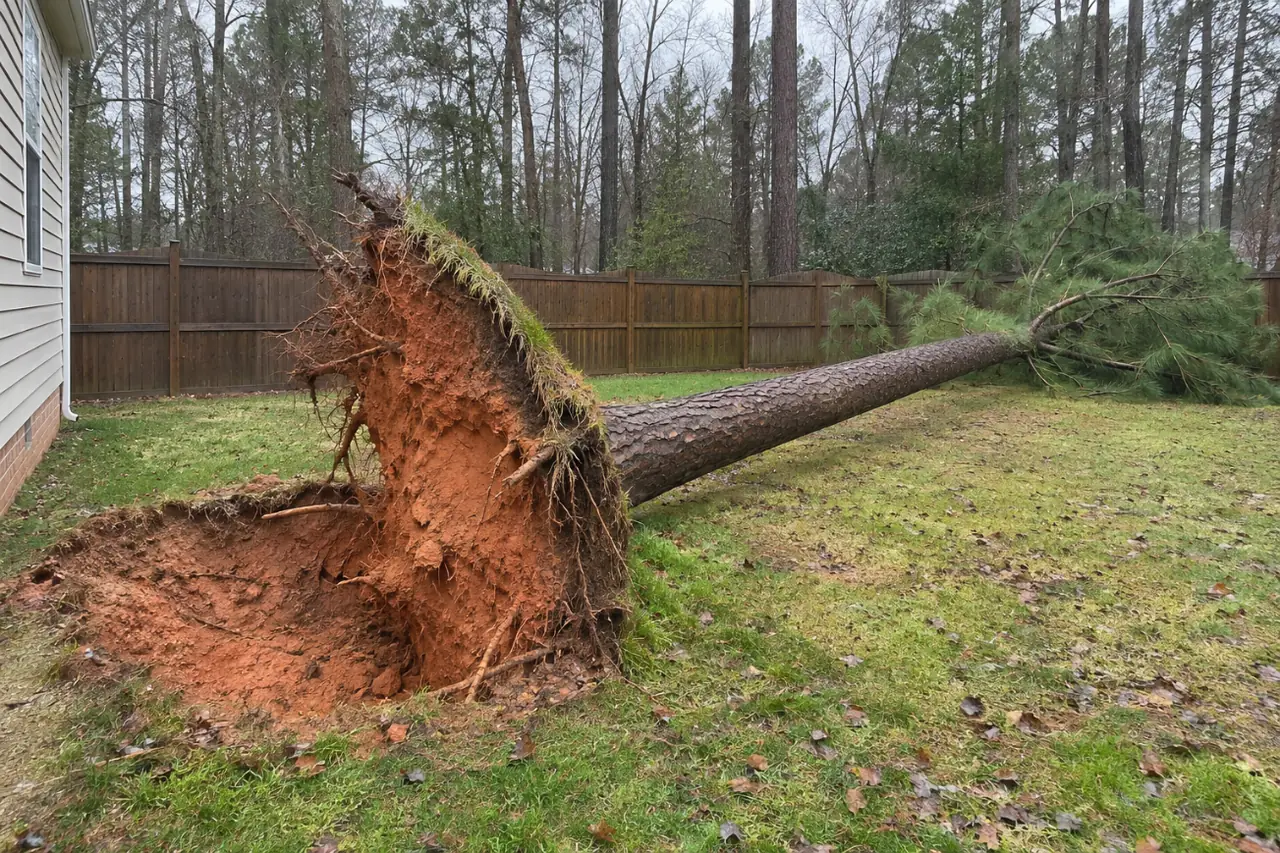
Who pays for a tree that fell in a storm?
The NC Department of Insurance's homeowners FAQ covers the usual questions (NCDOI homeowners FAQ, checked Nov 21, 2026):
- If a tree falls on your home or another structure, your own homeowners policy would generally cover the damage.
- Removal of the tree itself is covered at a reasonable expense, up to $500 for any one loss, but only when the tree struck a structure or blocked the driveway.
- Damage to a car from a falling tree goes on the auto policy's comprehensive (other than collision) coverage, not the homeowners policy.
- NCDOI's consumer line is 855-408-1212.
When the tree was the neighbor's, your own policy is still usually the first stop. NC State Extension's farm law team notes that the insurer may later seek repayment from the neighbor, and that storms don't settle the question by themselves: an owner who ignored a tree that was dead, leaning hard or root-damaged can still be found negligent (NC State Extension, July 25, 2021, checked Nov 21, 2026). Hold on to the contractor's written price and final invoice, because the adjuster will ask for them.
Should a storm-bent pine be cut or left?
The NC Forest Service's guide to storm-damaged southern pines says mature trees with root-sprung, cracked, twisted or broken stems show no recovery, and neither do mature pines leaning more than 45 degrees. Mature pines leaning less than 15 degrees recover fully; between 15 and 45 degrees they recover only partly and stay vulnerable to the next storm (NC Forest Service, checked Nov 21, 2026). That guide is written for forest stands; a yard pine leaning toward a house deserves a stricter eye. More on the pine page.
What happens after the tree is off the house?
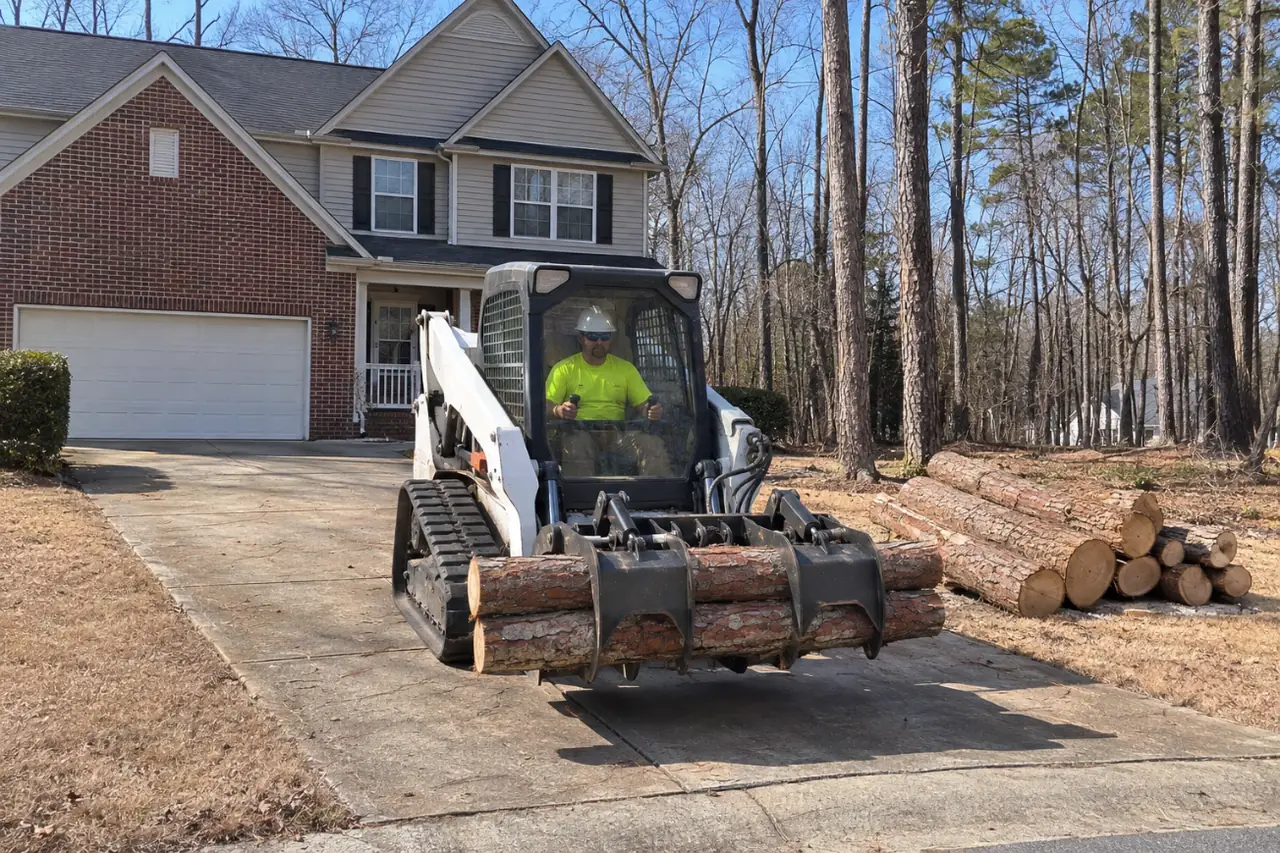
The crew cuts the tree off the roof in pieces, starting with the parts not holding weight, and lowers or lifts them away; a crane is sometimes the safest way to take the load off a damaged roof. Once the weight is gone a roofer can tarp or repair. Ask the contractor what the price covers: getting the tree off the house only, cutting the rest of the tree in the yard, hauling the wood, and grinding the stump are often separate lines. The town's weekly yard waste pickup does not take large amounts of brush from more than one tree (Town of Wake Forest, checked Nov 21, 2026).
Storm questions
How quickly can a crew get here?
That depends on the storm and how many trees are down across the area. Calling early gets your tree on the list; the contractor will tell you where you stand when they call back.
Should I cut the tree off my car myself?
Not if the trunk or limbs are bent or resting on each other. Wood under load can spring or roll when cut. Photograph it for the auto claim and leave the cutting to the crew.
Can I prevent the next one?
Partly. Dead limbs, a fresh lean, a split crotch, fungus at the base, and pines turning rust-colored all show up before the storm. Having a tree over the house looked at in calm weather also avoids storm pricing: Lawn Love lists emergency removal at $450 to $3,000, against $385 to $1,070 for a typical planned removal (Lawn Love, page dated Oct 5, 2026; checked Nov 21, 2026). See pruning and removal.