
Pine Tree Removal in Wake Forest, NC: Leaning, Broken and Dying Loblolly
Short version
Loblolly pines in Wake Forest, NC usually come down for one of three reasons: ice or wind has broken or tipped them, they lean toward the house, or bark beetles are killing them. The NC Forest Service's storm guide says mature pines leaning more than 45 degrees, or with cracked, twisted or broken stems, don't recover, and NC State Extension says beetle-attacked pines fade from green to yellow to red (both checked Nov 21, 2026).
If a pine near your house has started to lean, lost its top or turned color, call (984) 324-0250 and one independent local contractor will come look at it and price taking it down.
Why do loblolly pines break in ice and wind?
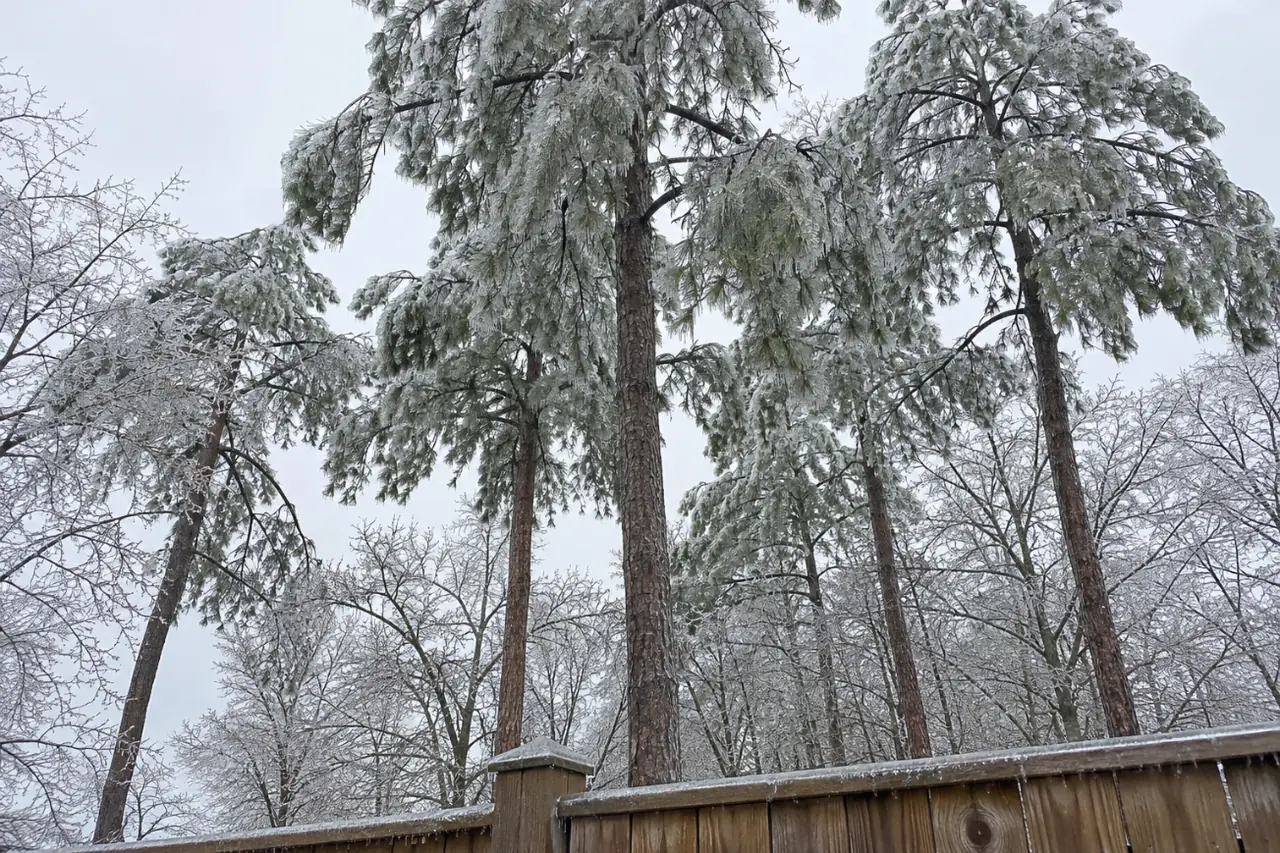
A loblolly in a yard puts its height into one tall, straight stem and carries its needles in a tuft at the top. Ice adds weight up where the trunk has the least to hold it, and wind pushes on that same crown, so pines tend to snap partway up or tip over at the roots rather than shed small limbs the way an oak does.
The record bears that out. After the December 2002 ice storm, North Carolina's utility regulators reported that evergreens caused the most problems for the power system, with many of them falling from outside the utility rights-of-way (NC Utilities Commission and Public Staff, September 2003, checked Nov 21, 2026). Six years earlier, half of Hurricane Fran's 24 deaths in North Carolina were caused by falling trees (NC State Climate Office, checked Nov 21, 2026).
Will a pine that leans after a storm straighten up?
The NC Forest Service's guide to evaluating storm-damaged southern yellow pines, written for forest stands, sorts trees this way (NC Forest Service, checked Nov 21, 2026):
| Mature pine after a storm | What the guide expects |
|---|---|
| Leaning less than 15 degrees | Full recovery |
| Leaning 15 to 45 degrees | Partial recovery; likely suppressed and vulnerable to the next storm |
| Leaning more than 45 degrees | No recovery |
| Root-sprung, cracked, twisted or broken stem | No recovery |
| Visible root damage, especially with a lean over 45 degrees | Expected to die |
| Broken top | Side branches take over as the leader; a slight crook is likely |
In a forest, a partly recovered pine is just slower timber. In a backyard, a pine leaning 20 degrees toward a bedroom is a different calculation, and soil bulging up opposite the lean shows the roots have let go. The guide also notes that storm damage weakens a tree's defenses and raises the risk of a pest outbreak, which leads to the next section.
How can I tell if bark beetles are in my pine?
An NC State Extension publication on pine bark beetles (Aug 4, 2022, checked Nov 21, 2026) describes the beetles that kill pines in North Carolina:
- Southern pine beetle, which the guide calls "the worst pest of southern forests."
- Ips engraver beetles, which move into pines weakened by drought, overcrowding, storm or fire injury, or a lightning hit.
- Black turpentine beetle, which attacks recently wounded trees, such as those hurt by heavy equipment or storms.
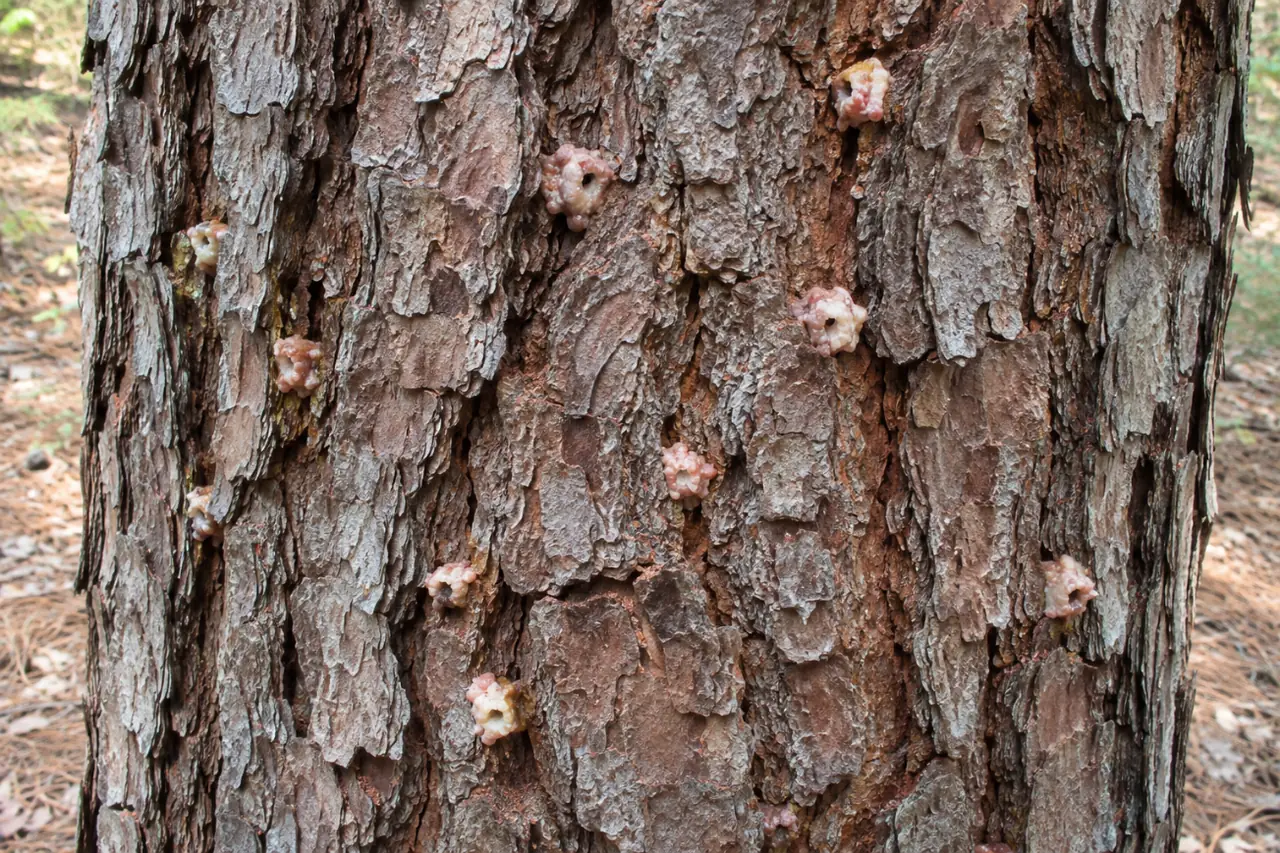
The signs to look for are pitch tubes, where sap pushed out at a beetle's entry hole hardens into what the guide calls "an almost popcorn-like appearance," and needles that pale, turn yellow and finally go red, leaving a "red-topped" tree. Black turpentine beetle attacks often leave large pitch tubes on the lower 15 feet of the trunk. The guide cautions that pitch tubes don't always tell you which beetle it is, and that badly stressed trees may not produce them at all.
Is a pine with beetles in it worth saving?
For southern pine beetle, the guide's control is to cut infested trees plus a buffer of green trees around them; cut-and-remove is the most effective option, at 97 percent efficacy. With Ips and black turpentine beetles, the publication calls management seldom warranted in forests, though heavily infested trees may be removed to cut the population and the risk to nearby trees. In a yard, a pine that has gone red is dead or dying either way, and a dead pine standing over a house, fence or street is the part that matters.
Why do pines die after a house is built or a driveway poured?
Construction wounds trunks and roots, and the beetle guide lists wounding by equipment as a trigger for black turpentine beetles. Wake Forest has grown fast: 47,601 people in the 2020 census (town's 2026 demographic profile), and an estimated 65,591 in July 2026 by the town Planning Department's count (Town of Wake Forest), both checked Nov 21, 2026. Every new street, addition or pool means machines near trees. A pine that was scraped or had its roots cut during building is worth watching for pitch tubes and fading needles for the next few years.
How does a tall pine come down near a house?
The same way any big tree does, with a few pine-specific points:
- A healthy pine is usually climbed with spikes, limbed on the way up, and the trunk taken down in sections. A dead or beetle-killed pine is brittle, so the contractor may prefer a lift or crane over climbing it.
- When a tall pine leans over the house with nowhere to drop it, a truck crane set on wood cribbing in the driveway lifts each section over the roof.
- The town wants logs over 6 inches across cut to 2 feet or shorter if they go to the curb, with brush capped at 8 cubic yards a week (Town of Wake Forest, checked Nov 21, 2026). A whole pine usually leaves on the crew's truck.
The tree removal page covers methods in more detail.
What does pine removal cost?
LawnStarter puts a typical pine removal at $925 (updated Oct 5, 2026). HomeGuide lists $200 to $1,600 for most pines and $2,000 to $3,000 for pines 100 feet or taller, and Angi lists $250 to $1,500 (all checked Nov 21, 2026). A crane, a dead brittle trunk or a backyard with no truck access push it up. See the cost page.
Pine questions
Is there a town permit for taking down a pine on a Wake Forest, NC lot?
Not on a residential lot under 5 acres, unless the pine is in a required streetyard, buffer or tree save area, or in the strip the town maintains along the street. See the town tree rules.
Should I take down healthy pines near the house before a storm?
That's your call; a sound pine with a full crown and no lean isn't the same risk as a damaged one. Under North Carolina's negligence standard, an owner's exposure grows when a danger was reasonably foreseeable, like a dead tree or one leaning hard toward the neighbor (NC State Extension, checked Nov 21, 2026).
Will cutting one infested pine save the others?
With southern pine beetle, removing infested trees promptly, plus a buffer of green trees, is the control the Extension guide recommends. Ips beetles follow stress, such as drought, storm damage and lightning, according to the same guide, so keeping stress off the remaining pines matters too.